
 Back to all case studies
Patient case Study
John’s treatment experience with CREXONT twice-daily dosing1
Learn about the considerations that informed his treatment approach
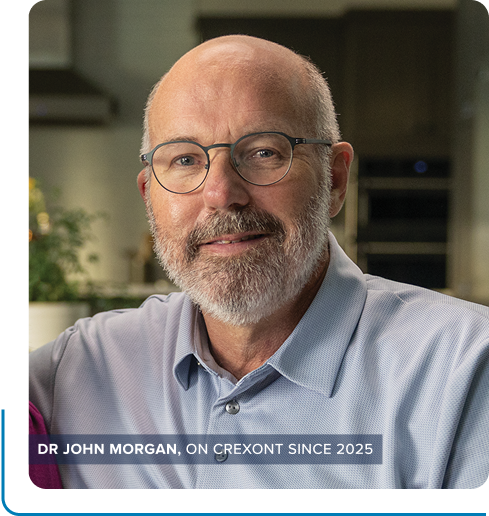
John’s Diagnostic Journey
John had spent years as a Movement Disorder Specialist (MDS) recognizing the signs of Parkinson’s disease in others. But he never expected to see those same signs in himself. When a resting tremor began affecting his right leg, he turned to a trusted colleague, also an MDS, who diagnosed him in 2020. Experiencing the condition firsthand gave John a deeply personal and uniquely formed perspective on his own care journey.
John’s Previous Treatment
John’s previous Parkinson’s treatment journey started with the following medications:
- MAO-B inhibitor
- Dopamine agonist
- RYTARY one 48.75/195 mg (carbidopa/levodopa) capsule three times daily (total daily levodopa dose 585 mg/day)
As an MDS, John was familiar with the risk of dyskinesia that came with IR CD/LD and the potential wearing “off.” That and the frequent dosing requirements dissuaded him from ever taking IR CD/LD himself.

87.2% of patients (out of 617 patients) in the study were on IR and controlled-release LD therapy. Study included 415 patients with PD who reported wearing “off” in a self-administered questionnaire, including 23 patients with disease duration less than 2.5 years.2
“There are things you don’t notice until you live them. Like how hard it is to turn over in bed, or how stiff your whole body can feel when you wake up. It’s not just weakness. It’s like moving in a weighted suit.”
—John
John’s Switch to CREXONT
John made the transition to CREXONT taking:
- One 52.5/210 mg (carbidopa/levodopa) capsule three times daily
After a couple of days, John checked in with his healthcare provider and needed to reduce his dosing frequency. His healthcare provider updated his dose to one 70/280 mg (carbidopa/levodopa) capsule twice daily.
The simplicity of twice-daily dosing fit easily into John’s demanding hospital workdays. Today, as a Movement Disorder Specialist, he brings that experience into conversations about treatment options and considers therapies like CREXONT when discussing care with appropriate patients.

For patients converting to CREXONT from RYTARY (carbidopa and levodopa) extended-release capsules
Initiate CREXONT on an approximately 1:1 mg basis using the LD component for conversion
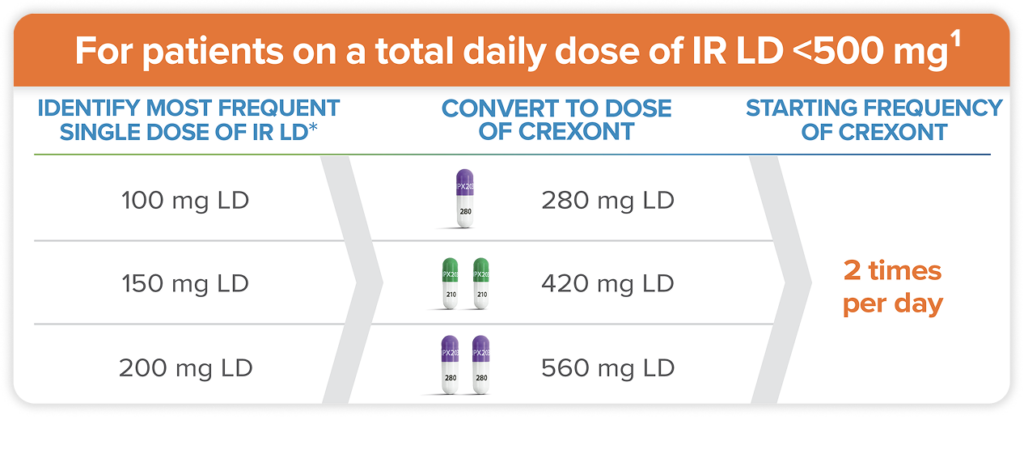
- Evaluate vitamin B6 levels before and during treatment with carbidopa/levodopa therapies and supplement as needed. Patients may start and continue CREXONT while taking vitamin B6 supplements
- Treatment with carbidopa/levodopa, including CREXONT, may reduce vitamin B6 levels; higher doses may further increase the risk of deficiency, which has been associated with seizures that did not respond to traditional anti-seizure medications and resolved only after vitamin B6 administration
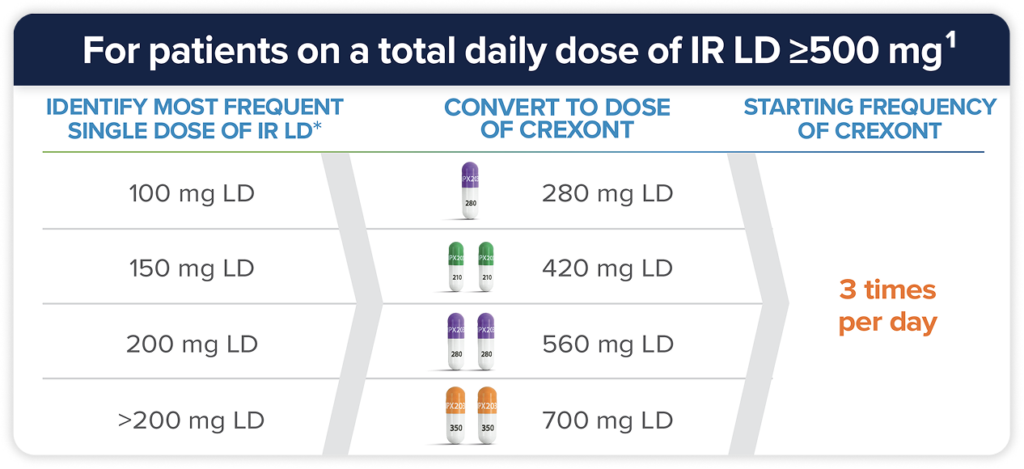
*If 2 or more IR CD/LD doses correspond to the most frequently used single dose, select the highest of the IR CD/LD doses.1
- Evaluate vitamin B6 levels before and during treatment with carbidopa/levodopa therapies and supplement as needed. Patients may start and continue CREXONT while taking vitamin B6 supplements
- Treatment with carbidopa/levodopa, including CREXONT, may reduce vitamin B6 levels; higher doses may further increase the risk of deficiency, which has been associated with seizures that did not respond to traditional anti-seizure medications and resolved only after vitamin B6 administration
John’s Life With CREXONT1
John hasn’t experienced any side effects since taking CREXONT. Although he manages several other health issues, having his ongoing symptoms effectively managed has allowed him to take things day by day, continue his active lifestyle, and spend quality time with his wife, Lori.
John’s experience with CREXONT is his own and may not reflect the experience of every patient. For some patients, CREXONT may cause falling asleep during daily activities. Side effects may include nausea and anxiety. Individual results will vary. Talk to your patients to see if CREXONT is right for them.
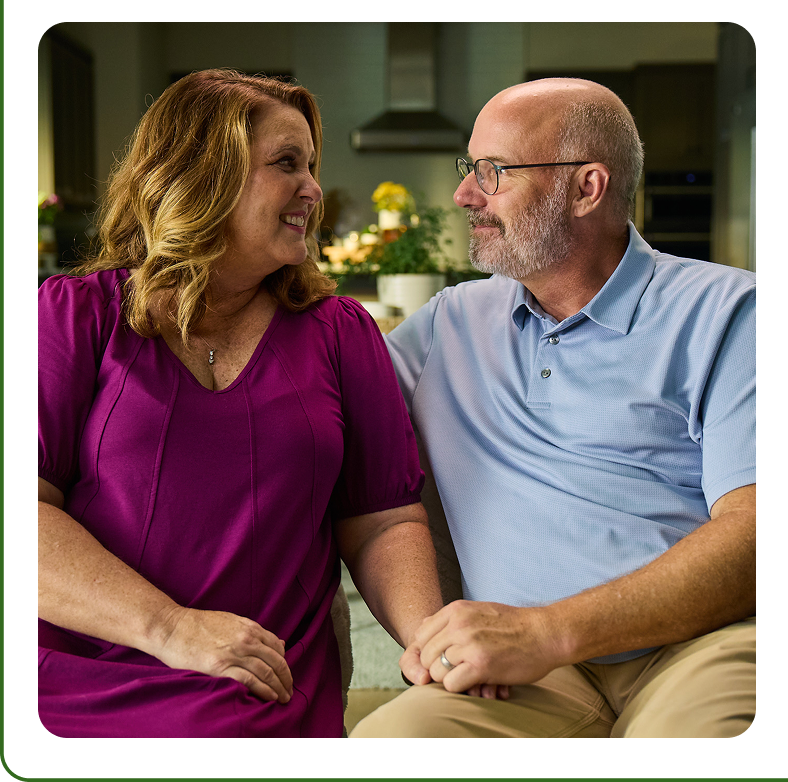
“We live our lives. We do what we want to do. CREXONT allows me to think about medicine less often and just live.”
—John

Use the dosing tool to convert from IR CD/LD to CREXONT
Learn how CREXONT can fit your patients’ needs, and find out how to convert your appropriate patients from IR CD/LD to CREXONT.
Find out about savings programs for your patients
IMPORTANT SAFETY INFORMATION
Indications and Usage
CREXONT® (carbidopa and levodopa) extended-release capsules for oral use is indicated for the treatment of Parkinson’s disease, post-encephalitic parkinsonism, and parkinsonism that may follow carbon monoxide intoxication or manganese intoxication in adults.
Dosage and Administration
- Evaluate vitamin B6 levels before and during treatment with carbidopa/levodopa therapies.
- Levodopa-naïve patients: Starting dose is 35 mg carbidopa/140 mg levodopa taken orally twice daily for the first three days; thereafter, dosage may be increased gradually as needed
- For patients converting to CREXONT from immediate-release carbidopa/levodopa, dosages are not substitutable on a 1:1 basis. See full prescribing information Section 2.2 for instructions
- For patients converting from Rytary® (carbidopa and levodopa) extended-release capsules, initiate CREXONT on an approximately 1:1 mg basis using the levodopa component for conversion
- CREXONT may be taken up to four times daily. The maximum recommended daily dosage is 525 mg carbidopa/2100 mg levodopa
- CREXONT may be taken with or without food. CREXONT capsules should not be chewed, divided or crushed. For patients who have difficulty swallowing, the capsule can be opened and the entire contents can be sprinkled on a small amount of applesauce and consumed immediately without chewing. Patients should not store the drug/food mixture for future use.
- CREXONT should not be taken with alcohol
Contraindications
Nonselective MAO inhibitors.
Warnings and Precautions
- CREXONT may cause falling asleep during activities of daily living, somnolence or dizziness. Patients should avoid activities that require alertness such as driving and operating machinery until they know how CREXONT affects them
- It is important to avoid sudden discontinuation or rapid dose reduction to reduce the risk of withdrawal symptoms such as high fever or confusion. Patients who are discontinuing CREXONT should taper off with healthcare provider guidance
- Consider dose reductions or stopping CREXONT in patients with hallucinations or impulse control disorders (e.g., gambling, sexual urges, or uncontrolled spending)
- Consider dose reduction in patients with dyskinesia
- Treatment with carbidopa/levodopa, including CREXONT, may contribute to reduced vitamin B6 levels. Seizures associated with vitamin B6 deficiency have been reported. Seizures were refractory to traditional anti-seizure medications and were only resolved after vitamin B6 administration. Supplement with vitamin B6 as necessary
- Other symptoms of vitamin B6 deficiency may occur, including depression, confusion, cheilosis, glossitis, dermatitis, anemia, and/or neuropathy. Supplement with vitamin B6 as necessary
- Patients with a major psychotic disorder should not be treated with CREXONT
- Monitor patients with a history of cardiovascular disease for cardiac function
- Monitor patients with a history of peptic ulcer for upper GI hemorrhage
- Monitor patients with glaucoma for increased intraocular pressure
Adverse Reactions
The most common adverse reactions (incidence ≥ 3% and greater than immediate-release CD/LD) are nausea and anxiety.
Drug Interactions
Iron salts and dopamine D2 antagonists, including metoclopramide, may reduce the effectiveness of CREXONT.
Use in Specific Populations
Pregnancy: Based on animal data, CREXONT may cause fetal harm. There are no adequate data on the developmental risk associated with the use of CREXONT in pregnant women.
Breastfeeding: The developmental and health benefits of breastfeeding should be considered along with the mother’s clinical need for CREXONT.
Geriatric patients: There were no differences in safety outcomes between patients less than 65 years of age, 65-75 years of age, or 75 years and older.
To report SUSPECTED ADVERSE REACTIONS, contact Amneal Global Patient Safety at 1‑877‑835‑5472, or FDA at 1‑800‑FDA‑1088 or www.fda.gov/medwatch
Please see full Prescribing Information for CREXONT.
Content is for guidance only. Please use clinical judgment when prescribing CREXONT. Dosage is individualized for each patient.
References: 1. CREXONT [package insert]. Bridgewater, NJ: Amneal Pharmaceuticals LLC; 2024. 2. Stocchi F, Antonini A, Barone P, et al. Early detection of wearing off in Parkinson disease: the DEEP study. Parkinsonism Relat Disord. 2014;20(2):204-211.