
Frequently asked questions
Questions about CREXONT? Here are some answers
Limitations of IR CD/LD
What are the limitations of immediate-release carbidopa/levodopa (IR CD/LD)?
Even with optimal management, frequent dosing and “Off” time with IR CD/LD can lead to increased burden and reduced quality of life for patients as Parkinson’s disease (PD) progresses.1-5
While IR CD/LD has been the gold standard in PD treatment for over 50 years, it has limitations.6,7 Due to the short half-life of levodopa and a narrowing therapeutic window, many patients experience “Off” time and wearing “off” periods as their disease progresses. This can negatively impact their quality of life.5,8,9The CREXONT difference
How does CREXONT differ from other carbidopa/levodopa (CD/LD) formulations available today?
CREXONT is an extended-release formulation of CD/LD that features a mucoadhesive polymer that no other oral CD/LD treatment
provides.10-13 This novel extended-release technology is designed to optimize absorption by adhering to the area of absorption for
longer.11 *In a pharmacokinetic study, CREXONT levodopa plasma levels lasted longer than immediate-release CD/LD and RYTARY in patients with Parkinson’s disease.1,11
*Exact mechanisms and sites of absorption are unknown.
What makes CREXONT’s extended-release (ER) technology different from other oral carbidopa/levodopa (CD/LD) formulations like RYTARY?
CREXONT’s novel ER technology lies in its formulation, which combines immediate-release (IR) granules with ER pellets. The IR CD/LD granules dissolve rapidly, while the ER levodopa (LD) pellets help sustain LD plasma levels.10,11*
The ER technology is designed to delay disintegration through an enteric polymer, optimize absorption by adhering longer to the area of absorption with a mucoadhesive polymer, and release levodopa gradually via a sustained-release polymer.11 †
In a pharmacokinetic study, CREXONT LD plasma levels lasted longer than IR CD/LD and RYTARY in patients with Parkinson’s disease.1,11
*Exact mechanisms and sites of absorption are unknown.
†Based on the time that LD plasma levels were maintained above 50% of Cmax.
Efficacy
How does CREXONT impact “Good On” time?
In RISE-PD, CREXONT delivered more “Good On” time with less frequent dosing. Patients taking CREXONT experienced a statistically significant improvement in “Good On” time (0.5 hours per day; P=0.019) with an average dose frequency of 3 times per day compared to 5 times per day with optimized immediate-release carbidopa/levodopa.10,11*†
“Good On” time is defined as the sum of “On” time without dyskinesia and “On” time with non-troublesome dyskinesia.10
*0.5 hours per day is the LS mean difference.11
†P value based on change from end of Week 7 (baseline) to Week 20 (end of study) or early termination, as assessed by the patient’s PD diary.10,11
How does CREXONT impact total daily “Off” time?
In RISE-PD, patients treated with CREXONT experienced significantly less “Off” time (0.5 hours per day; P=0.025) with less frequent dosing vs optimized immediate-release carbidopa/levodopa.10,11*
*P value based on change from end of Week 7 (baseline) to Week 20 (end of study) or early termination, as assessed by the patient’s PD diary.10,11
What did the post hoc analysis from RISE‑PD reveal about duration of benefit per dose of CREXONT?
In a post hoc analysis of the primary endpoint in RISE-PD, CREXONT provided 1.6 more hours of “Good On” time per dose vs optimized immediate-release carbidopa/levodopa (IR CD/LD).11*†
*“Good On” time per dose was defined as daily “Good On” time (hours) divided by the daily dose frequency in the subject’s stable dose regimen, as determined at the end of the dose adjustment period for subjects randomized to IR CD/LD and at the end of the dose conversion period for subjects randomized to CREXONT.11
†1.6 more hours per dose is the LS mean difference.11
Are there additional data for CREXONT beyond RISE‑PD?
CREXONT is being evaluated in ELEVATE-PD, a Phase 4, open-label trial assessing real-world efficacy and safety in patients switching from other oral therapies.14*
In an interim analysis of the first 55 patients after 6 weeks of treatment with CREXONT, patients experienced14:
- An increase of 2.76 hours of “Good On” time per day
- A decrease of 2.70 hours of “Off” time per day
- 3.84 hours of “Good On” time per dose†
The data presented are an interim analysis of an open-label study and should be considered within the context of the broader Phase 3 data available. Medical or therapeutic decisions should rely on established evidence, clinical guidelines, and the judgment of qualified healthcare professionals.
*Other oral therapies include immediate-release carbidopa/levodopa (IR CD/LD) (with or without a bedtime dose of controlled-release CD/LD), IR CD/LD plus a catechol-O-methyl transferase (COMT) inhibitor, or RYTARY.14
†“Good On” time per dose was defined for a 3-day Parkinson’s disease diary as the total duration of “Good On” time over all valid days in the diary divided by the total number of doses taken during those days.14
Patient types for CREXONT
Can CREXONT be used in treatment‑naïve patients or in early Parkinson’s disease?
CREXONT can be used in all stages of disease including treatment-naïve patients, previously treated patients, patients with early Parkinson’s disease (PD), and patients with advanced PD.10
CREXONT is approved for adult patients with PD, post-encephalitic parkinsonism, or parkinsonism caused by carbon monoxide or manganese intoxication.10
Can CREXONT be used in patients currently stable on immediate-release carbidopa/levodopa (IR CD/LD)?
Patients currently taking IR CD/LD, controlled‑release CD/LD, or any other oral CD/LD formulation, including extended‑release formulations such as RYTARY, may be switched to CREXONT.10
For guidance on determining the appropriate dose conversion for your patients, please refer to the Dosing and Administration section in the Prescribing Information or use the CREXONT Dosing Tool.
Can CREXONT be used in patients taking a catechol-O-methyl transferase (COMT) inhibitor?
Yes, CREXONT can be used in patients already taking a COMT inhibitor (eg, entacapone or ONGENTYS®). Patients can also discontinue the COMT inhibitor when initiating CREXONT.10
For patients currently treated with carbidopa/levodopa plus COMT inhibitor the initial total daily dose of levodopa in CREXONT may need to be increased if the COMT inhibitor is discontinued.10
Can patients switch back to immediate-release carbidopa/levodopa (IR CD/LD) from CREXONT if needed?
Patients taking CREXONT can switch to IR CD/LD if clinically appropriate. Advise patients to contact their healthcare provider before stopping CREXONT.10
Discontinue CREXONT gradually. Instruct patients to call their healthcare provider immediately if they experience withdrawal symptoms such as fever, confusion, or severe muscle stiffness. Please refer to the Prescribing Information for more details.10
Dosing
Does CREXONT reduce total daily dosing frequency compared with immediate-release carbidopa/levodopa (IR CD/LD)?
In RISE-PD, CREXONT delivered more “Good On” time with less frequent dosing. Patients taking CREXONT experienced a statistically significant improvement in “Good On” time (0.5 hours per day; P=0.019) with an average dose frequency of 3 times per day compared to 5 times per day with optimized IR CD/LD.10,11*†
CREXONT is the only oral CD/LD formulation approved for twice-daily dosing and can be taken up to 4 times per day, offering dosing flexibility to meet individual patient needs.10
CREXONT dosing is based on the patient’s total daily levodopa dose and their most frequently used single levodopa dose.10
For guidance on determining the appropriate dose conversion for your patients, please refer to the Dosing and Administration section in the Prescribing Information or use the CREXONT Dosing Tool.
*0.5 hours per day is the LS mean difference.11
†P value based on change from end of Week 7 (baseline) to Week 20 (end of study) or early termination, as assessed by the patient’s PD diary.10,11
How do I convert a patient from immediate-release carbidopa/levodopa to CREXONT?
Conversion is based on the patient’s total daily levodopa dose and their most frequently used single levodopa dose. CREXONT doses are not interchangeable with other products on a milligram-to-milligram basis.10
For guidance on determining the appropriate dose conversion for your patients, please refer to the Dosing and Administration section in the Prescribing Information or use the CREXONT Dosing Tool.
How should I manage patients switching from RYTARY?
For patients converting from RYTARY (carbidopa and levodopa) extended-release capsules, CREXONT should be initiated on an approximately 1:1 mg basis using the levodopa component for conversion. For guidance on determining the appropriate dose conversion for your patients, please refer to the Dosing and Administration section in the Prescribing Information.10
What should I know before prescribing CREXONT?
Evaluate vitamin B6 levels before and during treatment with carbidopa/levodopa therapies, and supplement as needed. Patients may start and continue CREXONT while taking vitamin B6 supplements.
Treatment with carbidopa/levodopa, including CREXONT, may reduce vitamin B6 levels; higher doses may further increase the risk of deficiency, which has been associated with seizures that did not respond to traditional anti-seizure medications and resolved only after vitamin B6 administration.
Other symptoms of vitamin B6 deficiency may occur, including depression, confusion, cheilosis, glossitis, dermatitis, anemia, and/or neuropathy. Supplement with vitamin B6 as necessary.
What is the recommended starting dose frequency for CREXONT?
CREXONT is the only extended-release carbidopa/levodopa (ER CD/LD) formulation with the potential for just twice-daily dosing and can be taken up to 4 times per day.10
For patients starting CREXONT who are treatment-naïve, the recommended starting dose frequency is 2 times per day for the first 3 days, and may be increased gradually up to 4 times per day as needed.10
For patients switching from immediate-release (IR) CD/LD to CREXONT, the recommended starting dose frequency of CREXONT is based on the current total daily dose of IR levodopa (LD).10- For patients taking a total daily dose of IR LD <500 mg, the recommended starting dose frequency of CREXONT is 2 times per day
- For patients taking a total daily dose of IR LD ≥500 mg, the recommended starting dose frequency of CREXONT is 3 times per day
- After 1–3 days, the dose strength or frequency may be adjusted as needed based on the patient’s clinical response and tolerability, up to 4 times per day
How should I determine whether to adjust dose strength or frequency for patients taking CREXONT?
After 1–3 days on CREXONT, follow up with your patients and adjust the dose strength or frequency as needed based on the patient’s clinical response and tolerability.10
- For patients poorly controlled on their current dose:
- Consider increasing the dose strength of CREXONT. Dose may be increased gradually up to a maximum daily dose of
525 mg/2100 mg carbidopa/levodopa (CD/LD)
- Consider increasing the dose strength of CREXONT. Dose may be increased gradually up to a maximum daily dose of
- For patients who are experiencing wearing “off” between doses:
- Consider increasing the dose frequency of CREXONT. CREXONT may be taken up to 4 times per day, up to a maximum daily dose of 525 mg/2100 mg CD/LD
- For patients who are experiencing dyskinesia:
- Consider decreasing the dose of CREXONT
Use clinical judgment when adjusting the dosage of CREXONT.
For guidance on determining the appropriate dose conversion for your patients, please refer to the Dosing and Administration section in the Prescribing Information or use the CREXONT Dosing Tool.
Can CREXONT dosing be individualized?
CREXONT dosing is individualized based on each patient’s current treatment regimen, symptom control, and other factors.10 CREXONT is available in four different strengths and may be administered 2 to 4 times daily. The maximum recommended daily dosage of CREXONT is 525 mg of carbidopa and 2100 mg of levodopa.10
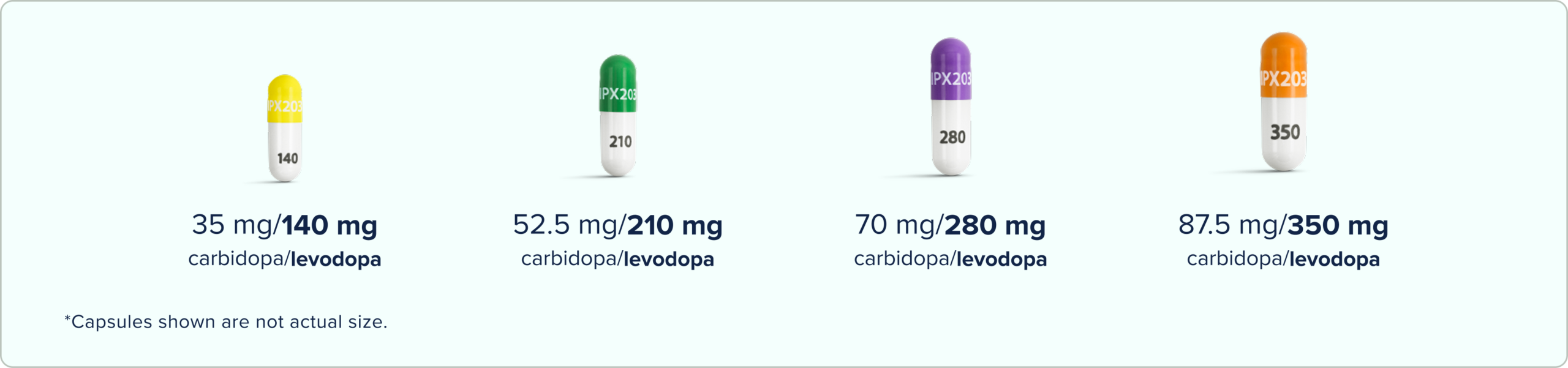
For guidance on determining the appropriate dose conversion for your patients, please refer to the Dosing and Administration section in the Prescribing Information or use the CREXONT Dosing Tool.
What should I do if a patient experiences wearing “off” on CREXONT?
If a patient experiences wearing “off” on CREXONT, depending on the patient’s current therapy, the dose and dosing frequency may be increased. CREXONT may be administered up to 4 times daily. The maximum recommended daily dosage of CREXONT is 525 mg of carbidopa and 2100 mg of levodopa.10
For guidance on determining the appropriate dose conversion for your patients, please refer to the Dosing and Administration section in the Prescribing Information or use the CREXONT Dosing Tool.
How long should I wait before adjusting dose strength or frequency?
The strength and frequency of CREXONT can be reassessed after 1–3 days and adjusted based on patient response and tolerability until the dose is optimized.10
Asking patients to use a symptom tracker may help monitor symptoms and response, making it easier to determine when dose adjustments are needed.
What is the maximum recommended daily dose of CREXONT?
Can CREXONT be taken with other Parkinson’s disease (PD) medications?
In the RISE-PD study, approximately 73% of patients in the CREXONT group and 63% in the oral immediate-release carbidopa/levodopa group were taking at least 1 additional class of PD medication at baseline. These medications were continued provided doses were stable for at least 4 weeks prior to screening.10
CREXONT can be taken with other PD medications; however, please refer to the Drug Interactions section of the Prescribing Information for important considerations.10
Should patients track motor symptoms when starting CREXONT?
Can CREXONT be taken with food?
Absorption of levodopa (LD) may be decreased by a high-protein meal. While CREXONT may be taken with or without food, the peak plasma concentrations of LD were observed approximately 2 hours after CREXONT was taken with a high-fat, high-calorie meal.10
Please refer to the Prescribing Information for more details.
Can CREXONT be taken with iron supplements or multivitamins?
Iron salts or multivitamins containing iron salts can form chelates with levodopa and carbidopa and can cause a reduction in the bioavailability of CREXONT. If iron salts or multivitamins containing iron salts are co-administered with CREXONT, monitor patients for worsening Parkinson’s symptoms.10
See full Important Safety Information below and refer to the Prescribing Information here.
Are there specific dietary considerations I should discuss with patients?
As with other oral levodopa (LD) treatments, patients should consider taking the first dose of the day about 1 to 2 hours before eating. In addition, patients should also be advised that a change in diet to foods that are high in protein may delay the absorption of LD and may reduce the amount taken up in the circulation.10
While CREXONT can be taken with or without food, you should inform patients that a high fat, high calorie meal may delay the absorption of LD and the onset of action by 2 to 5 hours.10
Please refer to the Prescribing Information for more details.
Safety
What are the most common adverse reactions?
The most common adverse reactions with CREXONT (incidence ≥ 3% and greater than immediate-release carbidopa/levodopa) are nausea and anxiety.10
See full Important Safety Information below and refer to the Prescribing Information here.
Are there warnings or precautions associated with CREXONT therapy?
Warnings and precautions associated with CREXONT include10:
- May cause falling asleep during activities of daily living
- Avoid sudden discontinuation or rapid dose reduction to reduce the risk of withdrawal-emergent hyperpyrexia and confusion
- Cardiovascular Events: Monitor patients with a history of cardiovascular disease
- Hallucinations/Psychosis may occur
- Impulse Control Disorders: Consider dose reduction or stopping CREXONT if occurs
- May cause or exacerbate dyskinesia: Consider dose reduction
- Vitamin B6 deficiency and seizures: Evaluate vitamin B6 levels prior to initiating carbidopa/levodopa therapies, including CREXONT, and periodically during treatment, or if symptoms associated with vitamin B6 deficiency are identified. Symptoms of vitamin B6 deficiency include depression, confusion, cheilosis, glossitis, dermatitis, anemia, and/or neuropathy. If vitamin B6 levels are low, supplement to sufficient levels per standard of care. Patients may initiate and continue treatment with CREXONT while supplementing vitamin B6
Are there drug interactions with CREXONT?
The use of nonselective monoamine oxidase (MAO) inhibitors (eg, phenelzine and tranylcypromine) with CREXONT is contraindicated. Any nonselective MAO inhibitors should be discontinued for at least 2 weeks prior to initiating CREXONT.10
The use of selective MAO-B inhibitors (eg, rasagiline and selegiline) with CREXONT may be associated with orthostatic hypotension. Patients taking selective MAO-B inhibitors with CREXONT should be monitored.10
Dopamine D2 receptor antagonists (eg, phenothiazines, butyrophenones, risperidone, metoclopramide) and isoniazid may reduce the effectiveness of levodopa. Patients taking dopamine D2 receptor antagonists with CREXONT should be monitored for worsening Parkinson’s symptoms.10
Iron salts or multivitamins containing iron salts can form chelates with levodopa and carbidopa and can cause a reduction in the bioavailability of CREXONT. Patients taking iron salts or multivitamins containing iron salts with CREXONT should be monitored for worsening Parkinson’s symptoms.10
See full Important Safety Information below and refer to the Prescribing Information here.